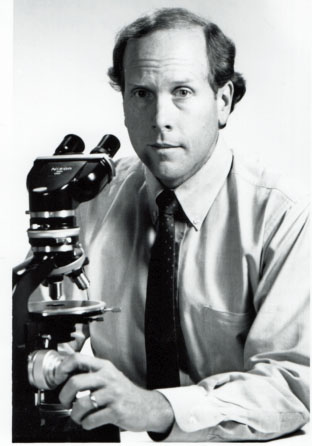
The Frank S. Welsh Co. was founded in 1974 in Ardmore, Pennsylvania, later moving to Bryn Mawr in 1977. The company incorporated under the name Welsh Color & Conservation, Inc. in 1998 and continued operations in Bryn Mawr until 2024, when it closed. The company specialized in the microscopical analysis of historic architectural paints, wallpapers, colors, pigments, and fibers. Company founder Frank S. Welsh published and lectured widely throughout his fifty-year career.
Following his own creative direction, Welsh created and developed a new specialization in architectural paint research and analysis within the field of historic preservation and became a major contributor to the advancement of the field during the last quarter of the twentieth century and into the twenty-first.
From those many years of persistence and study grew a body of work that eventually encompassed more than 1,750 projects throughout the United States and abroad, and ultimately formed a collection that includes approximately 50,000 archived paint and wallpaper samples, laboratory notebooks, microscope slides, photographs, publications, correspondence, and other materials documenting the investigation, analysis, and conservation of historic architectural paints and finishes. His research, publications, lectures, and consulting work brought professional recognition, including awards and service on national committees.
The Collection
During his early career, Welsh developed a close relationship with Roger W. Moss, Executive Director of the Athenæum of Philadelphia. Moss, who was himself deeply interested in historic paint colors, recognized that the documentation generated through Welsh’s architectural paint research possessed enduring scholarly value and should be preserved for future study. He therefore encouraged Welsh to continually donate extra copies of his bound reports as they were produced.
Those bound reports became the beginning of a much larger professional collection.
When Welsh closed his practice in 2024, he turned again to the Athenæum and donated the remainder of his professional archive: Project Report Files, paint and wallpaper samples, pigment samples and microscope preparations, laboratory notebooks, photographs, publications, correspondence, research materials, and related records accumulated over fifty years of practice.
The collection is preserved at the Athenæum so that it can continue to be used. Former clients and present-day stewards of historic properties can search for reports and documentation of earlier investigations and inquire about obtaining copies, while students, scholars, preservation professionals, and other researchers can use the accumulated material for continuing research and study.
Understanding the Collection: A Researcher’s Guide
The Athenæum developed a Finding Aid that identifies and describes the contents of the archival collection. Much of the knowledge embodied in the collection, however, cannot be conveyed by a Finding Aid alone. Relationships among Project Report Files, physical paint and wallpaper samples, microscope preparations, laboratory notebooks, photographs, and other materials developed through working methods refined over decades of practice and are not always apparent from the individual records themselves.
For that reason, Welsh prepared a Researcher’s Guide to accompany the collection—to provide historical context, explain its organization, and help researchers understand the relationships among its many components. More importantly, the Guide seeks to preserve some of the working knowledge that accompanied the collection throughout its active life, while that knowledge could still be recorded by the person who created and used the collection.
The Researcher’s Guide is therefore not a substitute for the Athenæum’s Finding Aid. The two are intended to be used together: the Guide helps a researcher understand the collection; the Finding Aid helps locate its archival materials.
Accessing and Using the Collection
There are three complementary ways to approach the collection.
The Researcher’s Guide
The historical and working context needed to understand how the different parts of the collection relate to one another and may be used together.
Understand the CollectionThe Finding Aid
The principal archival description and starting point for locating Project Report Files, physical samples, laboratory materials, photographs, research files, and related records.
Explore the CollectionFIND — Bound Reports
Over 100 bound Project Reports—hard-bound, in three-ring binders, or spiral-bound—are separately catalogued in FIND.
Find Bound ReportsThe bound reports are particularly important because they document the conclusions of individual investigations and were illustrated not only with photographs, but also with the actual Munsell visual color-reference samples matched to the historic paint colors identified during the investigations.
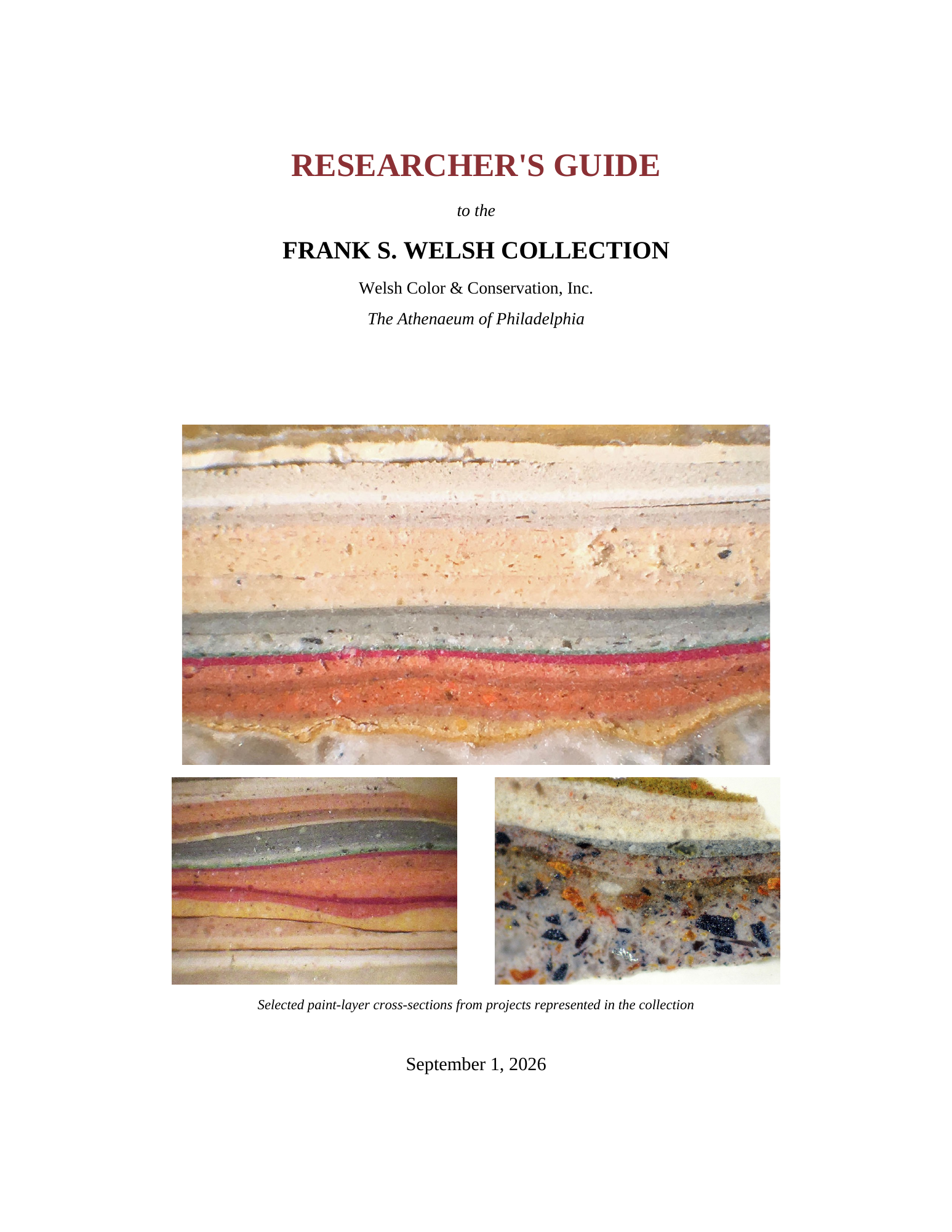
Researcher’s Guide
The complete digital Guide is available directly through this website. A printed reference copy is held at the Athenæum for researchers using the collection.
A Record of Discovery
The Frank S. Welsh collection documents more than fifty years during which architectural paint research and analysis developed from the careful visual examination of paint-layer sequences into an increasingly sophisticated investigative process incorporating pigment identification, microscopical cross-section analysis, precise color measurement, photomicrography, and systematic laboratory documentation. That progression survives not only in the finished reports, but also in thousands of original paint and wallpaper samples, microscope slides, laboratory notebooks, photographs, and supporting research materials.
Throughout his career, Welsh also believed that the results of research should be documented and shared. Publications, lectures, newsletters, and technical reports became an important complement to his consulting practice, allowing investigative methods and discoveries to become part of a broader exchange of knowledge within the historic-preservation field. All of these are in the collection.
For those who explore the collection, Welsh hopes it will be understood not simply as an archive of completed projects and accumulated materials, but as a record of discovery—of how evidence was examined, conclusions were reached, and methods evolved through experience, scientific inquiry, and the exchange of knowledge with others.
A Note About Examining the Original Samples
The Athenæum does not currently have microscopes available for examination of the collection’s original paint samples or prepared pigment slides. Researchers may, however, make arrangements in advance with the Athenæum to bring their own equipment for use while working with the collection.
Original paint samples may be examined with a stereomicroscope, allowing researchers to observe paint stratigraphy, layer relationships, surface characteristics, and other features that may not be fully conveyed through written descriptions or photographs.
The collection also contains the glass pigment slides prepared during the original investigations. Researchers wishing to examine these preparations may arrange to bring their own polarizing light microscope to the Athenæum.
Subject to Athenæum policies and staff supervision, these materials may be manipulated and examined but not altered or subjected to destructive analysis. Used together with the corresponding Project Report Files, bound reports, laboratory notebooks, photographs, and other documentation, they offer researchers an unusual opportunity to return to the physical evidence upon which the original investigations and interpretations were based.
Visiting and Contact
The complete digital Researcher’s Guide is available through this website, and a printed reference copy is held at the Athenæum for researchers using the collection.
Researchers should consult the Athenæum for current information concerning appointments, access to the collection, and reproduction procedures.
Should anyone wish to contact Frank S. Welsh directly concerning his professional work, research, or collection, the Athenæum’s collections staff can assist.